

OVERVIEW
WHY
Through the presentation of the archaeological artefacts
reveal the rich cultural and social context behind,
to bring audience interest, especially of the young generation to the history and culture of Eindhoven and the Netherlands
HOW
Hold an well-presented exhibition of the beaker and relevant artefacts,
feed enough context info of different subjects
using multi-media communication that would suit the info-hunting habit of younger generation:
short , quick, proactive, joyful
WHO
Local Eindhoven and Dutch citizens as majority, especially aged 20-50
WHEN
During DDW 24 when there would be a largest audience of the year, and later months
INCEPTION
Restoration Start
It started with a technical summon.
Late 2023 I received an assignment.
Dirk Vlasblom from Erfgoedhuis was looking for a clear skeleton
where he could glue some glass fragments on, together shown in a vessel shape.
A common friend of us pulled the string.
Of course I was happy to help.
With an accurate curve drawing, it'd only take 5 min to revolve the 3D model drawing.
The rest of job we can find a good SLA printer in the city.
Boom, done. How hard would it be?

Dirk at work
Dirk welcomed me with a whole table of glass and clay fragments.
On a plate he picked some pieces temporarily bound with paper tapes.
You could tell with one glance the glass pieces were not my age.
They were broken, grey, green, covered with subtle rainbow colored light.
Dirk told me he believes this original glass container is a rare one, could reach the height of 25 cm.
How much?
25.
OK... I put my hand to a rough position above table.
Is that abnormal? Right.
With hidden glory on his face, Dirk took out a large thick book, Glas Zonder Glans, pointed to a similar reference.
That was a complete ice glass beaker. Later I knew it's from Alkmaar, 17th century, 35cm tall beauty, super star.
That was the king.
Yet we had never found a beaker of roughly same age getting close to that size in the Netherlands.
The rest examples in the book fall between 10 to 20 cm tall mostly.
Sure I'm in. I shared his excitement of hunting some treasure unusual.
By then Dirk had drawn a first version sketch of the vessel's shape.
They even had a 3D drawing already. Just the 3D drawing was too much off the real size and proportion.
In the coming week, I re-modelled the curves and shape.
With some test prints, I landed on an acceptable PLA vessel that could sit exactly in the beaker bottom.
It turned out my story with the beaker didn't end there, but only got started.

Dirk‘s original sketch

Collecting bottom curve
Fortunately we had a relatively complete bottom
One point led to another.
Via Dirk's invitation, I attended the volunteer's gatherings at Erfgoedhuis every Wednesday evening,
where I learnt to puzzle the glass fragments.
Daan, my tutor, also a gold-and-mine-digging lover, had a lot on his plate ( literally ).
( Daan also helped with truck-transporting huge exhibiting boards later. Thank you, Daan )
He taught me how to distinguish and collect fragments possibly from a same vessel,
and left me to handle the puzzling work of the huge beaker itself.
By then we were already certain about 10 plus fragments, judging by the special glass colour and rough diameter scale.
Most of them had partial border aligned and connected to another.
It went smoother than expected.
See below, in two weeks we managed to collect and puzzle more than 85% of our final work.
They were taped on the skeleton prototype as a draft.
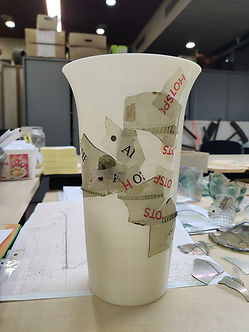
progress Feb.7 2024

progress Feb.14 2024
Local volunteers
During my resting time I sneaked around to check what other people were doing.
Now let's tell a bit more about our lovely volunteer group.
On Wednesday evening, come to Erfgoedhuis along side of Domme and Eindhoven Canal.
After 7pm you would witness a dozen of regular members arriving one by one.
Among them you'd find retired engineer, part-time gold&mine digger, university staff, social worker, castle researcher...
from every corner of the city.
after some warm chitchat, with a certain unspoken delight
people walk to their books, computers, workshop tables and throw themselves into
reading, artefacts archiving, ceramics puzzling, research presenting, field trip planning ...
Different as the volunteers' jobs may be, they share a common affection for archaeological findings.
I got very curious about the drive of that affection.
Because the phrase 'archaeological findings' is a bit too grand,
that in most cases it's simply old stuff that they are focusing.
They would be as happy as a child when a 1930s radio successfully broadcast again,
as proud as if they found gold when the metal detector weeps at a necklace in soil,
as devoted as if they were sculpturing Michelangelo's when they smear plaster off some ceramic fragments aged only decades.
Don't get me wrong. I have utmost respect for my volunteer friends and their passion.
Just honestly speaking, most artefacts they are dealing with, not only would they never find a place in the museum,
they are not even more valuable than the vase you keep by kitchen window.
I couldn't help wondering ( with all my respect! )
Is this just a kind of antique collecting maniac?
Or do they really find value in the old stuffs?
What is that true value they find?
Where is this continuous passion from?
I didn't wait long until the answer revealed itself.
On a Wednesday evening, I saw a lady staring at the wall of the meeting room.
On the wall was a huge aerial photo of old Eindhoven in 20th century or so.
I asked what she was looking at.
Her name was Rooney ( sorry I might have spelled it wrong ), probably at he age of 50 or 60.
Rooney pointed at the photo, with a smile started to review this city of old time.
We easily found Emmasingel, admired the old street view when they were not bombed yet.
We located the old hospital during the War, roughly periodised the photo according to the site around De Laak area.
We shared the current position of our homes, found Strijp along the newly built railway...
In ten minutes I got to learn a rough chronological history of city centre.
It was apparently also a joyful conversation for Rooney to introduce to a foreigner her hometown,
nostalgic smile on her cheeks and quite pride in the voice.
I suddenly came to realise why these people hold the old stuffs so dear,
and what value they could possibly bring.
They found their connection with this city through the 'historic artefacts'.
Every glance and touch is an unspoken conversation, a re-assuring of their root in culture.
With such connection comes a kind of sense of security, forming an unwavering core,
on base of which kindness and hospitality grows.
This was what I sensed at the moment.
Wait...If seemingly useless old stuffs could bring such acknowledgement of identity,
what could I as a designer do?
Don't I just have a best story-teller at my hand?
Very soon In March 2025 I put up a proposal of exhibition to Erfgoedhuis of this huge beaker we were restoring.